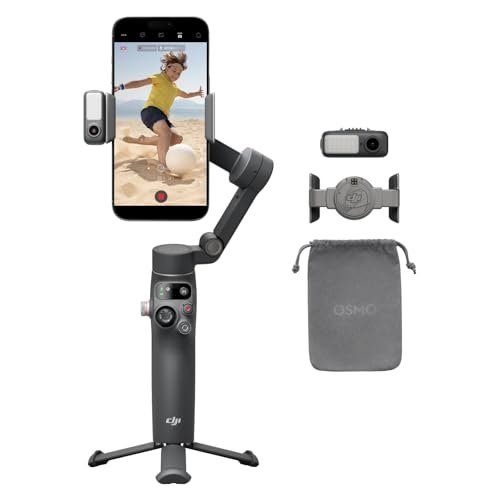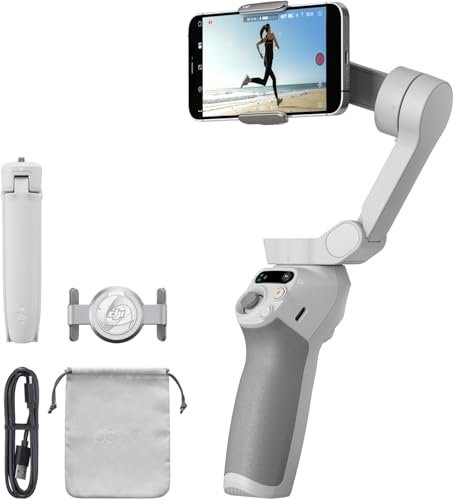
Ever tried shooting video with your DSLR handheld, only to find the footage looks like it was filmed during an earthquake? We’ve all been there! That’s where a good gimbal comes into play. A gimbal is a camera stabilizer that uses motorized axes to keep your camera perfectly level, no matter how much you move. The result? Silky-smooth, professional-looking video that’ll make your audience wonder if you hired a Hollywood crew.
Finding the best gimbal for DSLR can feel like a quest, especially with so many options out there. You need something robust enough to handle your camera and lens combo, packed with features, and easy to use. Whether you’re a budding filmmaker, a wedding videographer, or just someone who loves capturing high-quality family moments, investing in the right camera stabilizer is a game-changer. We’ve dug deep to bring you our top 5 picks, helping you cut through the noise and find the perfect match for your DSLR. Let’s dive in!
1. DJI RS 4, 3-Axis Gimbal Stabilizer for DSLR and…

The DJI RS 4 steps up as a fantastic choice for those looking for a versatile and efficient camera stabilizer. What truly makes it shine is its focus on streamlining the creative process. With its redesigned horizontal plate for native vertical shooting, you can switch from landscape to portrait for social media content in a snap, without messing around with extra accessories. It’s a real time-saver for creators on the go.
- 2nd-Gen Native Vertical Shooting: Effortlessly switch to vertical content creation.
- Joystick Mode Switch: Quickly toggle between PF, PTF, and FPV modes for precise control.
- Teflon-Coated Axis Arms: Ensures reduced friction and ultra-precise balancing.
- 3kg (6.6lbs) Payload Capacity: Ample space for mainstream mirrorless and DSLR camera/lens combos.
- Extended Tilt Axis: Offers expanded balancing space for larger setups.
- RSA Communication Port: Connects to extensive control accessories and third-party options.
- New BG70 High-Capacity Battery Grip (Sold separately): Extends runtime to 29.5 hours and powers accessories.
- Includes: Gimbal, BG21 Battery Grip, Quick-Release Plate, Extended Grip/Tripod, and more.
Pros:
* Super fast transition to native vertical shooting.
* Smooth and precise balancing thanks to Teflon coating.
* Good payload capacity for most DSLR setups.
* Extendable battery life with optional grip.
* Versatile control options via RSA port.
Cons:
* High-capacity battery grip sold separately.
* DJI Ronin app removed from Google Play; requires direct download from DJI website.
User Impressions: Users love the intuitiveness and quick setup of the RS 4, especially the vertical shooting feature. The build quality and smooth operation are frequently praised, making it a reliable workhorse for many videographers. The app download issue can be a minor hurdle, but generally, the performance outweighs this inconvenience.
2. DJI RS 4 Pro, 3-Axis Gimbal stabilizer for Camera for…

When you need to take your professional video production up a notch, the DJI RS 4 Pro is in a league of its own. It’s built for serious cinematographers, offering an increased payload capacity and enhanced motor torque to handle heavier, more complex camera setups, including many cinema cameras alongside top-tier DSLRs and mirrorless rigs. The integration of advanced LiDAR focusing technology really sets it apart, providing unparalleled autofocus accuracy, even at greater distances. This is arguably the best gimbal for DSLR users who demand cinema-grade control and precision.
- 2nd-Gen Native Vertical Shooting: Quick and effortless switch to vertical social content.
- 4.5kg (10lbs) Payload Capacity: Easily accommodates mainstream mirrorless/cinema camera and lens setups.
- 20% Increase in Motor Torque: Handles heavier loads with greater stability and responsiveness.
- Remote Dual Focus & Zoom Motor Control: Precise joystick control for gimbal movement or lens zoom.
- LiDAR Focusing: 76,800 ranging points within 20m for intelligent and accurate autofocus.
- Video Transmission Ecosystem: Broadens production possibilities with integrated installation and power supply.
- 29-hour Battery Runtime: Extendable with optional DJI RS BG70 High-Capacity Battery Grip (sold separately).
- Includes: Gimbal, BG30 Battery Grip, Quick-Release Plate, and more.
Pros:
* Impressive payload capacity for professional setups.
* Advanced LiDAR autofocus for superior tracking.
* Increased motor torque for better stability with heavy rigs.
* Extensive video transmission capabilities.
* Long battery life, especially with optional grip.
Cons:
* Premium price point.
* High-capacity battery grip sold separately.
* DJI Ronin app removed from Google Play; requires direct download from DJI website.
User Impressions: Professionals rave about the RS 4 Pro’s robustness and advanced features, particularly the LiDAR focusing which is a significant time-saver on set. Users appreciate its ability to handle larger lenses and cameras with ease, ensuring rock-solid stability. While the price is higher, many find the investment worthwhile for the capabilities it unlocks.
3. ZHIYUN CINEPEER Weebill 3E[Official], 3-Axis Lightweight…
![ZHIYUN CINEPEER Weebill 3E[Official], 3-Axis Lightweight...](https://m.media-amazon.com/images/I/41+kdEh7b2L._SL500_.jpg)
The ZHIYUN CINEPEER Weebill 3E hits a sweet spot for creators who need a lightweight, portable gimbal without sacrificing payload capacity. Its A4 paper-sized footprint makes it incredibly easy to carry around, while still supporting a solid 3kg (6.6 lbs) of gear. What truly helps it stand out is its commitment to ergonomic design, aiming to reduce fatigue during those long shooting days. If portability and comfort are high on your list, this could be the best gimbal for DSLR adventures.
- 3 kg (6.6 lbs) Payload: Lightweight (1.05 kg) with a substantial carrying capacity.
- Lightweight & Portable Design: A4 paper-sized for easy transport.
- Native Vertical Shooting: Achieve vertical content without extra accessories.
- 2.5 Sling Mode (Optional accessories): Reduces physical fatigue for low-angle shots.
- Bluetooth Shutter Control: Wireless control for camera recording and photo functions.
- 16H Max Battery Life: Robust battery for all-day shooting, with 14W PD fast charging.
- Wide-Axis Arm: Accommodates various mirrorless and DSLR cameras.
- Includes: Gimbal, tripod, quick release plate, USB charging cable, Panasonic control cable, manual, and warranty.
Pros:
* Extremely portable and lightweight.
* Comfortable ergonomic design reduces fatigue.
* Good payload for its size.
* Excellent battery life with fast charging.
* Supports native vertical shooting.
Cons:
* Specific control cables for Canon/Sony/other brands need to be purchased separately.
* Sling grip and wrist rest for Sling Mode 2.5 are sold separately.
User Impressions: Users appreciate the Weebill 3E’s compact size and how easy it is to throw into a bag. The comfortable grip design is a consistent highlight, making it ideal for longer shoots. While some wish the sling accessories were included, the core performance and portability make it a favorite for travel and run-and-gun shooting.
4. FeiyuTech SCORP-C Gimbal Stabilizer for Cameras DSLR and…

The FeiyuTech SCORP-C is designed with practicality and user convenience at its core. This camera stabilizer sets itself apart with its ingenious integrated hanging handle and a unique folding aileron bracket, meaning you can set it down almost anywhere without needing a separate tripod. It’s a thoughtful design choice that makes on-the-fly adjustments and diverse shooting angles much easier. For those who value intuitive setup and robust stability, the SCORP-C offers a compelling package.
- Broad Compatibility: Works with mainstream mirrorless and DSLR camera & lens combos (e.g., Sony, Panasonic, Canon, Nikon, Fujifilm).
- Integrated Hanging Handle: Complete lens control from upright or underslung angles.
- Tilted Handle Holding: Ergonomic design for comfortable grip.
- Set Down Anywhere: Integral folding aileron bracket eliminates the need for a separate tripod.
- Considerate Design: Three-axis motor lock, five-way center of gravity adjustment, center of gravity memory slider, Arca Quick Release Plate.
- Powerful Key Features: Professional modes, AB Trajectory Memory, Flash Mode (Three-Axis fast follow), Panoramic Photography, Time-lapse, Space Mode, Vertical-shooting.
- 2500mah Efficient Battery: 10-13 hour maximum runtime with 18W fast charging support (30 mins runtime in 5 mins).
Pros:
* Highly versatile integrated handle and stand.
* Excellent ergonomic design for comfortable holding.
* Quick and easy balancing with memory features.
* Wide range of shooting modes and intelligent features.
* Good battery life with fast charging.
Cons:
* Might feel bulkier than some ultra-compact options with the integrated handle.
* Specific payload limit needs careful checking for very heavy DSLR setups.
User Impressions: Many users praise the SCORP-C for its unique integrated handle, which offers great flexibility for different shooting styles. The ease of balancing and the ability to set it down without a tripod are big wins. It’s often recommended for its solid build and the comprehensive feature set available at its price point.
5. FeiyuTech SCORP 2 KIT Gimbal Stabilizer for DSLR and…

The FeiyuTech SCORP 2 KIT pushes the boundaries of convenience with its revolutionary built-in AI sensor. This isn’t just a gimbal; it’s a smart assistant that allows for intelligent tracking and gesture control without needing additional apps or accessories. For solo creators, vloggers, or anyone needing reliable subject tracking, this feature alone makes it a serious contender for the best gimbal for DSLR work. Combined with its upgraded quick-release system and robust compatibility, the SCORP 2 KIT is designed to empower your creativity.
- Built-in AI Sensor for Intelligent Tracking: Enables smart shooting and gesture control (OK gesture for tracking) without extra accessories or apps.
- Quick-release Design for Instant Vertical Filming: New L-shaped mounting plates allow direct vertical shooting.
- Supreme Power & Greater Compatibility: Load capacity up to 2500G, specifically built for mirrorless and SLR cameras.
- Wireless Control, Easy to Use: Connects to camera via cable or Bluetooth for shutter control and focus.
- Innovative Design: Integrated gun handle design for enhanced ergonomic comfort.
Pros:
* Groundbreaking built-in AI tracking – a game-changer for solo creators.
* Extremely fast and easy vertical filming setup.
* Strong payload capacity for a wide range of cameras.
* Wireless camera control adds great convenience.
* Comfortable and natural ergonomic grip.
Cons:
* AI tracking feature, while powerful, might have a learning curve for some gestures.
* Battery life details are not as explicitly listed as other models, though efficiency is implied.
User Impressions: The AI tracking is the star of the show for SCORP 2 KIT users, who describe it as incredibly convenient and effective for vlogging and dynamic shots. The upgraded quick-release system also gets high marks for its speed and reliability. Users appreciate the ergonomic design, making it comfortable even during extended use.
FAQ Section
Q1: Why do I need a gimbal for my DSLR?
A: A gimbal helps eliminate shaky footage caused by handheld movement. It uses motors to stabilize your DSLR on multiple axes, providing incredibly smooth, cinematic video that looks professional, even when you’re walking, running, or moving quickly.
Q2: What’s the difference between a gimbal and a tripod?
A: A tripod keeps your camera perfectly still in one fixed position, ideal for static shots. A gimbal, however, allows you to move freely while keeping your camera stable, making it perfect for dynamic shots, tracking subjects, and creating fluid camera movements.
Q3: How do I balance a DSLR on a gimbal?
A: Balancing involves adjusting the camera’s position on each axis (tilt, roll, pan) so that it remains level and doesn’t lean in any direction even when the gimbal is off. Most gimbals have adjustment arms and quick-release plates to help with this. Proper balancing is crucial for optimal performance and battery life.
Q4: What payload capacity do I need for my DSLR?
A: Check the combined weight of your DSLR camera body and your heaviest lens. Then, choose a gimbal with a payload capacity that comfortably exceeds that weight. Most DSLRs with standard lenses fall within the 2kg-4kg (4.4lbs-8.8lbs) range, but larger bodies and heavy cinema lenses will require gimbals with higher capacities like the DJI RS 4 Pro.
Q5: Can I use a gimbal with both DSLR and mirrorless cameras?
A: Yes, most modern gimbals are designed to be compatible with both DSLR and mirrorless cameras, as long as the combined weight (payload) falls within the gimbal’s supported range. Always double-check the manufacturer’s compatibility list if you have a specific camera model in mind.
Q6: How important is battery life on a gimbal?
A: Battery life is very important, especially for longer shoots or events. A longer battery life means less interruption for recharging. Look for gimbals offering 10+ hours of run time, and consider models with fast charging or optional high-capacity battery grips if you’re planning all-day shoots.
Q7: What are some common features to look for in a DSLR gimbal?
A: Beyond stabilization, look for features like:
* Native Vertical Shooting: For easy social media content.
* Integrated Stand/Handle: For versatility and convenience.
* AI Tracking: For intelligent subject tracking.
* Quick Release Plates: For fast setup and breakdown.
* Motor Locks: To secure axes during transport or balancing.
* App Control: For advanced settings and remote operation.
* Follow Modes: Different modes (Pan Follow, Tilt Follow, FPV) for creative shots.
Choosing the best gimbal for DSLR shooting is an investment in your video quality. Each of these top picks offers something unique, catering to different needs and budgets. We hope this guide helps you make an informed decision and elevates your videography to new, incredibly smooth heights! Happy shooting!