Ever found yourself struggling to capture that perfect shot of a soaring eagle or a fast-paced sports moment with your heavy telephoto lens? If so, you’re not alone. Balancing a bulky camera setup on a regular tripod head can be a real headache, leading to shaky footage or missed opportunities. That’s where a high-quality gimbal head comes into play. Designed specifically for stability and fluid movement with large lenses, a good gimbal head can transform your wildlife, sports, or even astronomical photography.
In this guide, we’re diving deep into some of the best gimbal heads for tripods available on the market. We’ll explore their unique features, pros, and cons to help you make an informed decision and finally achieve those buttery-smooth pans and tilts you’ve been dreaming of.
Why You Need a Gimbal Head for Your Tripod
Unlike traditional ball heads or pan-tilt heads, a gimbal head is engineered to support your camera and lens at their natural center of gravity. This innovative design allows for effortless, free-flowing movement, letting you track moving subjects with incredible precision and minimal effort. Imagine smoothly following a bird in flight or a race car zooming past – that’s the power of a quality gimbal head. They’re essential gear for any serious photographer using long, heavy lenses, ensuring optimal camera stability and balance.
Our Top Picks for the Best Gimbal Heads for Tripods
We’ve handpicked five excellent options that stand out for their build quality, performance, and user satisfaction. Let’s take a closer look!
NEEWER Gimbal Tripod Head Professional Heavy Duty Aluminum
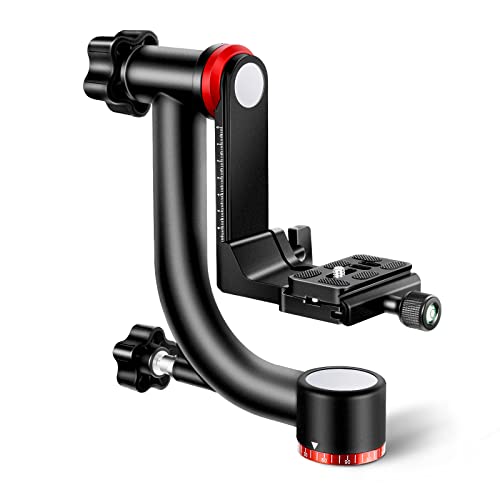
The NEEWER Gimbal Tripod Head is a sturdy and reliable choice for photographers who demand robust support for their heavy DSLR cameras and long telephoto lenses. Its professional-grade aluminum alloy construction means it’s built like a tank, ready to tackle challenging shooting conditions. What truly sets this gimbal head apart is its integrated bearing structure, which ensures exceptionally smooth and precise camera movements, making it a joy to track fast-moving subjects without any hitches or jerks.
-
Key Features:
- Solid aluminum alloy build with integrated load-bearing structure.
- Max load capacity of 30lb/13.6kg.
- Smooth camera movement thanks to a built-in bearing structure.
- 360° panning base with panoramic scales for precise rotation.
- Vertical & horizontal directions with adjustable swinging arm.
- Arca-Type quick release plate with 1/4″ mounting screw and rubber padding.
- Bubble level for accurate alignment.
-
Pros:
- Excellent stability for heavy setups.
- Very smooth panning and tilting.
- Durable, professional-grade construction.
- Versatile compatibility with most tripods and Arca-type plates.
-
Cons:
- Can be relatively heavy due to its aluminum build.
- Requires careful tightening to prevent camera slippage (as noted in instructions).
-
User Impressions: Users frequently praise the NEEWER GM101 for its impressive stability and fluid motion, especially considering its price point. Many find it an indispensable tool for wildlife and sports photography, noting how it significantly reduces arm fatigue during long shooting sessions. The solid build gives users confidence in its longevity.
K&F Concept Upgraded Gimbal Tripod Head, Exclusive

The K&F Concept Upgraded Gimbal Tripod Head brings a fresh perspective with its focus on enhanced smoothness and precision. Thanks to an exclusive lubricant and a new CNC process, this head boasts incredibly silky rotation, even in extreme temperatures. It’s also surprisingly lightweight for its impressive 44.09lbs (20kg) load capacity, making it a powerful yet portable option for professionals who need to manage large, expensive camera and lens combinations with ultimate control. The precise scales on its adjustable modes further cement its position as a high-precision tool.
-
Key Features:
- Exclusive lubricant for silky-smooth rotation in all temperatures.
- Upgraded CNC process for enhanced precision and durability.
- Constructed from premium aluminum alloy, including knobs.
- Impressive 44.09lbs/20kg weight capacity; weighs only 1.13kg.
- 4 adjustable modes for 360-degree horizontal and vertical rotation.
- 100mm range for horizontal/vertical arm adjustment with precise scales.
- Wide compatibility with 3/8″ or 1/4″ tripod screws and camera threads.
- Includes screw adapters and a quick-release plate.
-
Pros:
- Exceptional smoothness and fluidity of movement.
- High weight capacity despite being relatively lightweight.
- Robust damping lock holds heavy gear at any angle.
- Enhanced precision with clear adjustment scales.
-
Cons:
- The “exclusive lubricant” claim might sound like marketing speak to some.
- New CNC process may be an unknown for long-term durability comparison.
-
User Impressions: Photographers are consistently impressed by the K&F Concept’s buttery-smooth operation and its ability to handle very heavy setups without a hitch. Its lighter weight is a big plus for those who need to carry their gear over long distances. The precise adjustments are also frequently highlighted as a major benefit.
SIRUI PH-Series Carbon Fiber Gimbal Head (PH-10)

For photographers who are serious about shedding weight without sacrificing strength, the SIRUI PH-10 Carbon Fiber Gimbal Head is a dream come true. Crafted with a 10-layer carbon-fiber body, this gimbal head weighs in at a mere 0.98kg (2.16lbs) while still supporting a substantial 15kg (33lbs) load. This makes it an ideal companion for mirrorless setups with large telephoto lenses, perfectly balancing portability with robust performance for extensive outdoor shoots, from bird watching to sports.
-
Key Features:
- Lightweight 10-layer carbon-fiber body (0.98kg/2.16lbs).
- Supports up to a 15kg/33lbs load.
- Ideal for mirrorless cameras with 200mm-600mm telephoto lenses.
- Quick release plate with precision scale marks (1/4”-20 and 3/8” screws).
- Universal 3/8” Screw Port at the bottom for accessories.
- Security lock for quick release plate.
- Independent locking knobs for friction control and position settings.
- 360-degree rotating base and panoramic base for omni-directional creation.
-
Pros:
- Extremely lightweight, making it easy to transport.
- Excellent load capacity for its weight.
- Carbon fiber construction offers superb vibration dampening.
- Independent locking knobs provide fine control.
-
Cons:
- Carbon fiber models generally come at a higher price point.
- May feel less “heavy-duty” in hand compared to full metal alternatives (though it’s still very strong).
-
User Impressions: Users rave about the SIRUI PH-10’s incredible lightness, which makes a significant difference during long treks or extended shooting sessions. They consistently report rock-solid stability and smooth operation, even with large lenses. The independent locking knobs are a favorite feature for precise adjustments.
Wimberley WH-200 Wimberley Gimbal Head II – Made in USA

The Wimberley WH-200 Gimbal Head II is often considered the gold standard among professional photographers, and for good reason. Made in the USA, this gimbal head exudes quality, precision, and durability. Its legendary design allows you to perfectly balance your lens around its center of gravity, making even the heaviest lenses feel virtually weightless. This rugged piece of equipment offers unparalleled stiffness and smooth pan and tilt movement in a compact package, making it a reliable workhorse for dedicated pros.
-
Key Features:
- True gimbal-type design for balancing lenses around their center of gravity.
- Rugged design offering stiffness, capacity, and smooth movement.
- Compact and lightweight for its performance class.
- Arca-Swiss style clamp supports various medium and telephoto lenses.
- Anodized 6061 Aluminum Clamp, powder-coated Aluminum upright, Stainless Steel Fasteners.
- Proudly Made in USA.
-
Pros:
- Industry-leading smoothness and balance.
- Exceptional build quality and durability.
- Reputation for reliability and long-term performance.
- Designed and manufactured in the USA.
-
Cons:
- Significantly higher price point than most competitors.
- Simpler aesthetic compared to some feature-rich budget options.
-
User Impressions: The Wimberley WH-200 is consistently praised as an investment that pays off. Users highlight its incredibly fluid motion, effortless handling of massive lenses, and bulletproof construction. Many consider it the ultimate gimbal head, performing flawlessly for years, justifying its premium cost.
WEYLLAN Professional Gimbal Tripod Head Heavy Duty Carbon

The WEYLLAN Professional Gimbal Tripod Head offers a compelling blend of strength and portability, thanks to its 10-layer carbon fiber construction. Designed for heavy-duty use, it supports up to 33lbs (15kg) while remaining impressively lightweight, making it an excellent choice for dynamic shooting in challenging outdoor environments. Its bearing structure ensures smooth 360-degree rotation, perfect for capturing fast-paced action in wildlife or sports photography with unwavering stability and precision.
-
Key Features:
- Heavy-duty 10-layer carbon fiber construction.
- Max load capacity of 33lbs/15kg.
- Precise 360° panoramic movement with bearing structure.
- Smooth and stable horizontal and vertical rotation.
- Dual-screw Quick-Release Plate (1/4” and 3/8” screws).
- Anodized anti-oxidation surface (CNC precision machining).
- Equipped with a bubble level for accurate alignment.
-
Pros:
- Excellent strength-to-weight ratio due to carbon fiber.
- Very smooth and stable motion for tracking.
- Versatile quick-release plate for different cameras.
- Durable, corrosion-resistant surface treatment.
-
Cons:
- Being carbon fiber, it might be a higher investment than aluminum alternatives.
- Brand recognition might not be as high as some established names.
-
User Impressions: Photographers appreciate the WEYLLAN gimbal head for its sturdy yet lightweight design, making it easy to carry without compromising on stability. Many users note the smooth panning and tilting, which is crucial for capturing crisp images of moving subjects. The build quality and dual-screw plate are also frequently mentioned as positives.
Choosing the Best Gimbal Head for Your Needs
When picking one of the best gimbal heads for tripods, consider these factors:
- Weight Capacity: Ensure it can comfortably support your heaviest camera and lens combination.
- Material: Carbon fiber offers lightweight durability, while aluminum provides robust strength often at a lower cost.
- Smoothness: Look for models with bearing structures or special lubricants for fluid movement.
- Quick Release System: Arca-Swiss compatibility is standard and highly recommended for ease of use.
- Weight of the Head Itself: If portability is key, a lighter carbon fiber option might be best.
- Build Quality & Adjustments: Look for solid construction, precise scales, and easy-to-use locking knobs.
By considering these points, you’ll be well on your way to finding the perfect gimbal head to elevate your photography.
Frequently Asked Questions (FAQ)
Q1: What is a gimbal head primarily used for?
A1: A gimbal head is primarily used for balancing large, heavy telephoto lenses and professional camera bodies on a tripod. It allows photographers to smoothly track fast-moving subjects like birds in flight or athletes, making it ideal for wildlife, sports, and astrophotography.
Q2: Do I really need a gimbal head, or can a ball head do the job?
A2: While a ball head can support heavy gear, it doesn’t offer the same effortless balance and smooth, free-flowing movement as a gimbal head. For very long lenses (e.g., 300mm f/2.8 or larger), a gimbal head is far superior for tracking motion, reducing strain, and preventing nose-heavy setups.
Q3: What’s the main difference between a carbon fiber and an aluminum gimbal head?
A3: The main difference lies in weight and vibration dampening. Carbon fiber gimbal heads are significantly lighter and tend to absorb vibrations better, making them excellent for portability and sharp images. Aluminum heads are generally heavier but often more affordable and still very robust.
Q4: How do I properly balance my camera and lens on a gimbal head?
A4: To balance your setup, first ensure the lens plate is attached correctly to your lens. Then, adjust the quick release platform up or down until the lens no longer “flops” forward or backward. Next, slide the lens forward or backward on the platform until it balances perfectly on the horizontal axis, staying put at any angle.
Q5: What maximum load capacity should I look for in a gimbal head?
A5: You should look for a gimbal head with a maximum load capacity that is at least 2-3 times the weight of your heaviest camera and lens combination. This ensures stability, safety, and smooth operation, preventing the head from feeling strained or “sticky.”
Q6: Are quick-release plates universal for gimbal heads?
A6: Most modern gimbal heads use the Arca-Swiss style quick-release system, which has become a de facto standard. While many brands are compatible, it’s always best to check if the gimbal head explicitly states “Arca-Swiss compatible” to ensure your existing plates or lens collars will fit.
Q7: Can I use a gimbal head for video recording?
A7: Yes, gimbal heads are excellent for video recording, especially when tracking moving subjects. Their smooth pan and tilt capabilities allow for fluid camera movements, which are crucial for professional-looking video. However, they are not designed for the precise, controlled drag movements that a dedicated fluid video head offers.