Ever tried to capture that elusive bird in flight or a fast-paced sports moment with a heavy telephoto lens, only to end up with blurry shots or aching arms? If so, you’re not alone. Handling long, heavy lenses requires more than just a sturdy tripod; it demands a specialized tool designed for smooth, effortless movement: a gimbal head. For any serious wildlife, birding, or sports photographer, investing in the best gimbal head for photography isn’t just an upgrade – it’s a game-changer.
Unlike traditional ball heads or pan-tilt heads, a gimbal head perfectly balances your camera and lens, making them feel virtually weightless. This allows you to track moving subjects with incredible fluidity and precision, ensuring you don’t miss that decisive moment. But with so many options out there, how do you pick the right one?
We’ve scoured the market to bring you a curated list of the top contenders. In this guide, we’ll dive deep into what makes a great gimbal head and review seven fantastic options, helping you find the best gimbal head for photography to match your needs and elevate your shooting experience.
What is a Gimbal Head and Why Do You Need One?
Imagine trying to hold a giant seesaw perfectly still while also being able to tilt and pan it effortlessly with just one finger. That’s essentially what a gimbal head does for your camera and lens. It pivots around your lens’s center of gravity, creating a balanced system that allows for buttery-smooth movements across horizontal and vertical axes.
You might be wondering, “Why can’t I just use my standard tripod head?” Here’s why a gimbal head is indispensable for certain types of photography:
- Heavy Lenses: Standard tripod heads struggle with the weight and awkward balance of long telephoto lenses (e.g., 200-600mm, 300mm f/2.8, 400mm f/4). A gimbal head handles these behemoths with ease.
- Fluid Tracking: When you’re following a bird in flight or a racing car, you need to pan and tilt without jerking movements. Gimbal heads offer unparalleled smoothness, keeping your subject in crisp focus.
- Reduced Fatigue: Balancing a heavy lens manually is tiring. A gimbal head takes the strain off your arms and wrists, allowing for longer, more comfortable shooting sessions.
- Stability: Even with rapid movement, the balanced design ensures your setup remains stable, minimizing vibrations and maximizing sharpness.
In short, if your photography involves fast-moving subjects and long, heavy lenses, a gimbal head isn’t a luxury; it’s a necessity.
Factors to Consider When Choosing the Best Gimbal Head for Photography
Before we jump into the reviews, let’s quickly go over some key aspects to keep in mind when making your choice:
- Load Capacity: This is crucial. Ensure the gimbal head can comfortably support the combined weight of your heaviest camera body and telephoto lens. Always give yourself a little buffer.
- Material & Weight: Carbon fiber gimbal heads are typically lighter and stronger than aluminum ones, making them ideal for travel or long treks. However, aluminum options are often more budget-friendly and still very robust.
- Smoothness of Movement: Look for precision bearings and well-machined components that ensure fluid panning and tilting without hitches or sticking.
- Arca-Swiss Compatibility: Most quality gimbal heads use the Arca-Swiss quick release system, which is an industry standard. This ensures broad compatibility with your existing camera plates and accessories.
- Adjustability: The ability to precisely adjust the lens platform (horizontally and vertically) is key to achieving perfect balance, especially for different lens setups.
- Durability & Weather Sealing: If you’re shooting outdoors, resistance to dust, sand, and moisture can be a huge plus.
Now, let’s explore some of the best gimbal head for photography options available today!
1. SIRUI PH-Series Carbon Fiber Gimbal Head (PH-10)

The SIRUI PH-10 stands out as a top-tier choice for photographers who prioritize lightweight design without sacrificing strength. Crafted from 10-layer carbon fiber, this gimbal head offers an impressive load capacity for its modest weight, making it an excellent companion for long outdoor shoots where portability is key. It’s engineered for seamless operation with mirrorless cameras and telephoto lenses, providing the stability and smooth movements required for capturing wildlife, sports, and celestial events with ease.
Key Features:
– Lightweight 10-layer carbon-fiber body (0.98kg/2.16lbs)
– Supports up to 15kg/33lbs load capacity
– Ideal for mirrorless cameras and 200-600mm telephoto lenses
– Quick release plate with precision scale marks and security lock
– Independent locking knobs for precise friction control and position settings
– 360-degree rotating base and panoramic base for omni-directional creation
– Universal 3/8” Screw Port at the bottom for accessories
Pros:
– Extremely lightweight, reducing fatigue during long carrying or shooting sessions
– Excellent load capacity for its weight, handling substantial setups
– Smooth and precise independent locking knobs for fine adjustments
– Robust carbon fiber construction ensures durability
– Great for dynamic outdoor photography like bird watching and sports
Cons:
– May not handle the absolute heaviest professional cinema lenses (though sufficient for most telephoto setups)
– Higher price point due to carbon fiber construction
User Impressions:
Users frequently praise the SIRUI PH-10 for its incredibly light build, making it a joy to carry on long excursions. Many are impressed by its robust feel despite the low weight and the buttery-smooth panning and tilting, which significantly enhances their ability to track fast-moving subjects. It’s often highlighted as a fantastic value for a carbon fiber gimbal head.
2. K&F Concept Aluminum Alloy 360 Degree Panoramic Gimbal

The K&F Concept Gimbal Head is a testament to the brand’s commitment to continuous improvement, boasting a refined internal lubricant and superior sealing that address common issues like grease leakage. Built from durable 6061 aluminum alloy, it offers an impressive 20kg (44lbs) load capacity, making it a formidable choice for heavier camera and lens combinations. Its robust design ensures stable horizontal and vertical movements, providing photographers with the confidence to capture panoramic scenes and fast-moving subjects with exceptional fluidity.
Key Features:
– Improved third-generation lubricant for smoother operation
– High-quality sealing rings ensuring 0% grease leakage
– Constructed from rugged 6061 aluminum alloy
– High load capacity of up to 20kg/44lbs
– Horizontal adjustment of lens platform for precise center of gravity positioning
– Calibrated scale for repeatable lens positioning
– 360-degree rotating base and vertical arm for versatile panoramic photography
– Includes standard 1/4” quick release plate and bubble level with anti-slip design
Pros:
– Exceptional load capacity, suitable for very heavy professional setups
– Outstanding smoothness due to improved lubrication system
– Reliable and durable aluminum construction
– Excellent for panoramic photography with 360-degree rotation
– No reported grease leakage issues, ensuring long-term performance
Cons:
– Aluminum construction makes it heavier than carbon fiber alternatives
– May feel bulky for those prioritizing ultra-lightweight setups
User Impressions:
Photographers are highly impressed with the K&F Concept’s build quality and its incredibly smooth operation. The high load capacity is a recurring point of praise, allowing users to mount substantial gear without worry. Many highlight its value for money, offering professional-grade performance at a competitive price, making it a strong contender for the best gimbal head for photography in its class.
3. NEEWER Gimbal Tripod Head Professional Heavy Duty Aluminum
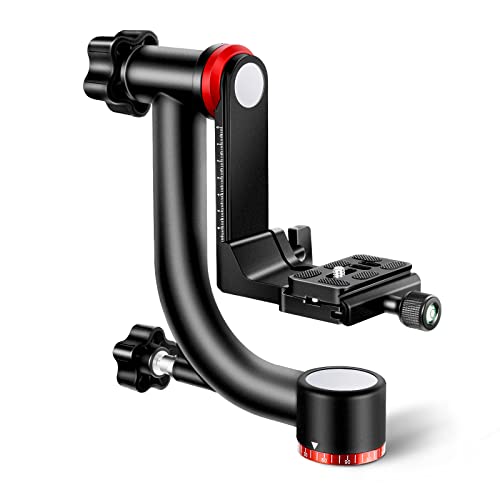
The NEEWER GM101 Gimbal Tripod Head is a workhorse designed for professional-grade stability and smooth operation. With its durable aluminum alloy construction and integrated load-bearing structure, it confidently supports heavy DSLR cameras and telephoto lenses, boasting a maximum load capacity of 30lb/13.6kg. Its built-in bearing structure ensures exceptionally smooth and easy adjustments, making it an ideal choice for birdwatching, wildlife, and sports photographers who need to track subjects with high accuracy and minimal effort.
Key Features:
– Durable aluminum alloy build with integrated load-bearing structure
– Maximum load capacity of 30lb/13.6kg
– Smooth camera movement with an advanced bearing structure
– Balances camera on vertical and horizontal axes for precise swiveling and rotation
– 360° panning base with panoramic scales and lock knob
– Vertical and horizontal shooting capabilities with adjustable swinging arm
– Arca-Type quick release plate with 1/4″ mounting screw and rubber padding
– Compatible with Sony, Canon, Nikon, and other DSLR/mirrorless cameras
– Bubble level for precise angle adjustment
Pros:
– Robust construction provides excellent stability for heavy gear
– Exceptional smoothness due to bearing structure, aiding in fluid tracking
– Versatile with 360° panning and easy vertical/horizontal adjustments
– Wide compatibility with various camera systems via Arca-Type plate
– Good value for its heavy-duty capacity and professional features
Cons:
– Aluminum construction means it’s heavier than carbon fiber alternatives
– Requires careful handling when loosening knobs to prevent camera drops
User Impressions:
Customers rave about the NEEWER GM101’s ability to handle heavy lenses with ease, often describing its movements as “buttery smooth.” The robust build instills confidence, and many appreciate the integrated bubble level for quick setup. It’s frequently recommended as a reliable and affordable option for those seeking a heavy-duty gimbal head for action-packed photography.
4. Movo GH800 MKII Carbon Fiber Professional Gimbal Tripod

The Movo GH800 MKII delivers professional-grade performance with the advantage of lightweight carbon fiber construction. Designed for fluid pan and tilt movements, its precision bearings make tracking fast-moving subjects feel effortless, making it an ideal companion for serious wildlife and birding enthusiasts. Despite its own light weight of just 2.75 lbs, it boasts an impressive 30 lbs (13.6kg) load capacity, ensuring stability and “weightless” flow for almost any camera and telephoto lens combination.
Key Features:
– Fluid panning and tilting with precision bearings
– Arca clamp and plate for horizontal and vertical adjustability
– Heavy-duty carbon-fiber build
– Supports up to 30 lbs (13.6kg) load capacity
– Relatively light at 2.75 lbs (1.25kg)
– Ideal for wildlife photography, birding, and outdoor uses
– 1-year Movo Warranty with U.S.-based support
Pros:
– Excellent balance of high load capacity and lightweight design
– Exceptional smoothness for tracking moving subjects
– Durable carbon fiber construction for long-lasting use
– Great value for a professional carbon fiber gimbal head
– Reliable U.S.-based customer support
Cons:
– While robust, carbon fiber can be more susceptible to impact damage than solid metal if dropped
– May still be considered a significant investment for hobbyists
User Impressions:
Users consistently praise the Movo GH800 MKII for its lightweight nature and the incredible smoothness of its movements. It’s a favorite among wildlife photographers who need to carry their gear over long distances. Many feel it provides exceptional value, offering a high-quality carbon fiber experience that rivals more expensive brands, making it a strong contender for the best gimbal head for photography in its category.
5. Fotopro E-6H Gimbal Head

The Fotopro E-6H Gimbal Head distinguishes itself with unique 3-in-1 functionality, seamlessly transforming from a gimbal head into a fluid head and a panoramic head with click stops. This versatility makes it an incredibly adaptable tool for a wide range of photographic pursuits, from breathtaking astro-photography (shooting straight up) to detailed macro shots (shooting straight down). Constructed with robust carbon fiber, it offers a lightweight yet strong platform capable of supporting up to 22.1 lb (10 kg), and its resistance to water, sand, and dust ensures reliable performance in challenging outdoor environments.
Key Features:
– Unique 3-in-1 functionality: Gimbal, Fluid, and Panoramic head with click stops
– Versatile shooting angles: Straight up for astro, straight down for macro
– Innovative backward shift for precise nodal point alignment in panoramas
– Built-in “Bowling Center” for effortless camera leveling
– Durable carbon fiber construction
– Supports up to 22.1 lb (10 kg) load capacity
– Waterproof, sand-proof, and dust-proof for extreme conditions
Pros:
– Unmatched versatility with 3-in-1 functionality
– Excellent for specialized shots like astro and macro in addition to telephoto tracking
– Precise nodal point alignment feature for flawless panoramas
– Extremely durable and weather-resistant design
– Lightweight carbon fiber construction for portability
Cons:
– Lower maximum load capacity compared to some heavy-duty alternatives
– Its unique features might be overkill for photographers solely focused on basic telephoto tracking
User Impressions:
Photographers are particularly impressed by the Fotopro E-6H’s innovative versatility, allowing them to tackle various shooting scenarios with one head. Its build quality and weather resistance are frequently highlighted, giving users confidence in challenging conditions. The “Bowling Center” leveling system is a favorite feature, simplifying setup and ensuring perfectly level shots.
6. ProMaster GH26 Professional Gimbal Head

The ProMaster GH26 Professional Gimbal Head is engineered for discerning photographers who demand exceptional precision and unwavering stability. Its advanced design ensures smooth movements and precise control, crucial for capturing stunning images with telephoto lenses. Built with rugged, professional-grade materials, the GH26 provides a robust and stable platform for even the heaviest camera and lens combinations, allowing photographers to easily track and follow fast-moving subjects with fluid, effortless operation.
Key Features:
– Exceptional precision and stability for high-quality results
– Rugged and durable professional-grade construction
– Supports heavy camera and lens combinations
– Smooth and effortless operation for tracking fast-moving subjects
– Precise control over panning and tilting movements
– Wide compatibility with various telephoto lenses and camera bodies
– Enhances shooting experience by reducing fatigue and improving balance
Pros:
– Outstanding precision and stability for critical focus and sharp images
– Very robust construction ensures long-term durability and reliability
– Effortless tracking capabilities for dynamic subjects
– Wide compatibility offers flexibility for various gear setups
– Designed to reduce photographer fatigue during extended use
Cons:
– Specific load capacity is not explicitly detailed in provided features (though implied heavy-duty)
– Likely heavier than carbon fiber models due to professional-grade construction
User Impressions:
Users consistently praise the ProMaster GH26 for its rock-solid build and incredibly smooth operation. Many remark on its “tank-like” quality, providing immense confidence when mounting expensive gear. It’s often recommended by professionals who prioritize durability and precise, consistent performance in demanding situations.
7. Andoer Heavy Duty Gimbal Head Gimbal Tripod Head with

The Andoer Heavy Duty Gimbal Head is a robust and budget-friendly option designed to provide smooth and quiet 360° panoramic shooting, both vertically and horizontally. Crafted from rugged metal, it boasts an impressive load capacity of up to 30Lbs (13.6kg), making it an ideal helper for panoramic photography and serious bird watchers with heavy setups. Its damping system ensures smooth and quiet movements, while the Arca-Swiss standard quick release plate and detailed scales allow for accurate position calibration and balancing.
Key Features:
– Rugged metal construction
– Supports up to 30Lbs/13.6kg heavy load
– Smooth and quiet 360° panoramic shooting (vertical and horizontal)
– Damping system for smooth and quiet movement
– Graduated lead rail for simple vertical position adjustment
– Arca-Swiss standard 1/4″ quick release plate with bubble level
– Detailed scale on pan and swing for accurate position calibration
– Bottom diameter 5cm/2″, with 3/8″ screw hole for tripod mounting
– Comes with a 1/4″ and 3/8″ convertible screw
Pros:
– Very high load capacity, suitable for professional and heavy gear
– Excellent value for its robust build and features
– Smooth 360° panning and tilting with effective damping
– Standard Arca-Swiss plate for wide compatibility
– Precise scales for repeatable setups and accurate balancing
Cons:
– Metal construction makes it heavier than carbon fiber alternatives
– May lack some of the premium finish or extremely refined feel of higher-end models
User Impressions:
Customers highly recommend the Andoer gimbal head for its incredible value and solid performance. They are often surprised by its robust build quality for the price point and praise its ability to handle heavy lenses with ease. The smooth movements and panoramic capabilities are frequently highlighted, making it a popular choice for hobbyists and professionals on a budget looking for the best gimbal head for photography without breaking the bank.
Frequently Asked Questions (FAQ)
Q1: What is the main purpose of a gimbal head?
A1: The main purpose of a gimbal head is to support heavy camera and telephoto lens setups, allowing photographers to balance their gear perfectly and track fast-moving subjects (like birds in flight or athletes) with incredibly smooth, fluid motion across both horizontal and vertical axes.
Q2: How is a gimbal head different from a ball head or pan-tilt head?
A2: A ball head uses a single locking mechanism to control all movement, which can be difficult to manage with heavy lenses. A pan-tilt head offers separate controls for horizontal and vertical movement but can still be cumbersome with large setups. A gimbal head, however, balances the lens at its center of gravity, making the heavy setup feel weightless and allowing for effortless, precise tracking with minimal friction, making it ideal for dynamic action photography.
Q3: Do I need a special tripod for a gimbal head?
A3: While you don’t necessarily need a “special” tripod, it’s crucial to have a very sturdy and stable tripod that can handle the combined weight of your camera, lens, and the gimbal head itself. Most gimbal heads have a standard 3/8-inch mounting thread at the bottom, making them compatible with most professional-grade tripod legs.
Q4: How do I balance my camera and lens on a gimbal head?
A4: Balancing your gear on a gimbal head involves adjusting the quick release plate forward/backward and the vertical arm up/down until the camera and lens sit perfectly level and remain in any position you leave them without drifting. This ensures the setup feels weightless and allows for the smoothest possible movements.
Q5: Are carbon fiber gimbal heads better than aluminum ones?
A5: Carbon fiber gimbal heads are typically lighter than aluminum ones, which is a significant advantage for portability and carrying on long shoots. They also offer excellent vibration damping. Aluminum gimbal heads, while heavier, are often more affordable and can be incredibly durable and robust. The “better” one depends on your budget, weight preference, and specific needs.
Q6: What’s the maximum weight a gimbal head can support?
A6: The maximum load capacity varies greatly between models, ranging from around 10kg (22lbs) for lighter carbon fiber models up to 30kg (66lbs) or more for heavy-duty professional versions. Always check the manufacturer’s specifications and ensure it exceeds the total weight of your heaviest camera and lens combination.
Q7: Can I use a gimbal head for landscape photography?
A7: While gimbal heads excel at tracking moving subjects, they can be used for landscape photography, especially if you’re using a very long telephoto lens to compress a scene or capture distant details. However, for typical wide-angle landscape shots, a lighter ball head or pan-tilt head is often more convenient and quicker to set up.
Conclusion
Choosing the best gimbal head for photography is a crucial decision for anyone serious about wildlife, sports, or action photography with telephoto lenses. Each of the products reviewed above brings something unique to the table, whether it’s the ultra-lightweight portability of carbon fiber, the sheer load capacity of heavy-duty aluminum, or innovative multi-functional designs.
Consider your primary shooting style, the weight of your gear, and your budget when making your choice. Whichever gimbal head you opt for, you’ll undoubtedly experience a significant upgrade in your ability to capture sharp, fluid images of fast-moving subjects. Happy shooting!