Ever tried shooting a video while walking, only to find the playback looks like an earthquake hit? We’ve all been there! Shaky footage can ruin even the most epic moments, turning your masterpiece into a blurry mess. That’s where a gimbal comes in, transforming your wobbly shots into silky-smooth, professional-looking videos.
Whether you’re a seasoned content creator, a budding vlogger, or just someone who loves capturing life’s moments with a smartphone or DSLR, investing in the best gimbal for mobile and DSLR can be a total game-changer. These incredible devices use motors and sensors to counteract unwanted movements, ensuring your footage remains steady, no matter how much you move.
But with so many options out there, how do you pick the right one? Don’t sweat it! We’ve scoured the market to bring you a hand-picked selection of the top gimbals and essential accessories that will elevate your videography game. Let’s dive in!
Our Top Picks for Stabilizing Your Shots
Here’s a rundown of some of the best gimbals and supporting gear that promise to keep your shots steady and your creativity flowing.
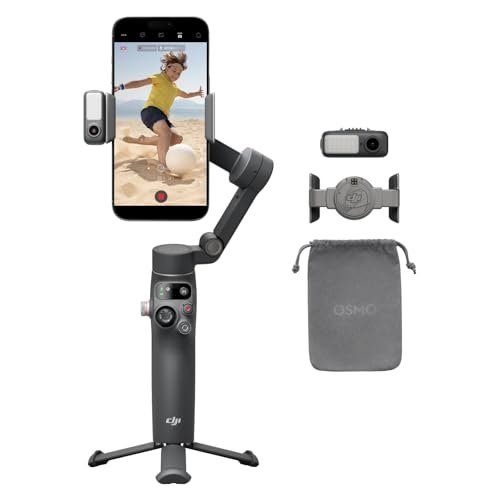
1. DJI Osmo Mobile 7P Gimbal Stabilizer for iPhone, Android

The DJI Osmo Mobile 7P is a real showstopper, designed for those who want to capture truly spectacular moments with their phone. What makes it stand out is its innovative Multifunctional Module, which cleverly packs intelligent tracking, a DJI Mic 2/DJI Mic Mini receiver, and even lighting features into one compact unit. This means you can get perfectly lit, perfectly tracked shots with crystal-clear audio, all in one go – it’s like having a mini production studio in your pocket!
-
Key Features:
- Multifunctional Module for intelligent tracking, mic reception, and lighting.
- Robust 3-axis gimbal stabilization for lossless stability.
- ShotGuides and One-Tap Edit via DJI Mimo app for easy pro-level editing.
- Quick power-on and magnetic phone clamp for instant filming.
- Built-in extension rod and tripod for versatile shooting.
- Up to 10 hours of operating time, with extra power for your phone.
- Dual-Lens Enhanced Tracking for smarter, steadier subject tracking.
-
Pros:
- All-in-one accessory module significantly enhances filming.
- Exceptional stability and smooth footage.
- User-friendly features like ShotGuides for beginners.
- Magnetic design for quick setup.
- Integrated extension rod adds versatility.
- Long battery life and power bank function.
-
Cons:
- DJI Mimo app requires direct download from DJI website for Android users.
- Higher price point due to advanced features.
- Might be overkill for very casual users.
-
User Impressions: Users rave about the ease of use and the truly “cinematic” results it delivers. The smart tracking and integrated lighting/mic capabilities are frequently highlighted as game-changers, making professional-looking content accessible to everyone. It’s seen as a solid investment for serious mobile content creators.
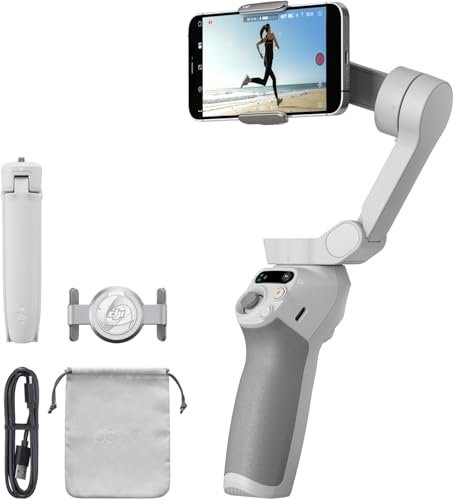
2. DJI Osmo Mobile SE, 3-Axis Phone Gimbal

The DJI Osmo Mobile SE is your go-to if you’re looking for an ultra-portable and surprisingly powerful phone gimbal without breaking the bank. It nails the essentials, offering fantastic 3-axis stabilization and the upgraded ActiveTrack 6.0, which means it can stick to your energetic kids or playful pets (or even yourself!) like glue. It’s incredibly convenient for on-the-fly shooting, thanks to its foldable design and quick magnetic clamp.
-
Key Features:
- Portable, foldable design with magnetic quick-release clamp.
- ActiveTrack 6.0 for enhanced subject tracking.
- Remote control via DJI Mimo app on Apple Watch.
- Effortless editing with ShotGuides and LightCut templates.
- Next-gen 3-axis stabilization for buttery smooth footage.
- Seamless landscape and portrait mode switching.
- New Status Panel for quick mode and battery checks.
-
Pros:
- Extremely portable and easy to set up.
- Excellent tracking capabilities with ActiveTrack 6.0.
- Great value for its performance.
- Intuitive controls and status display.
- Offers versatile shooting modes.
- Ergonomic, non-slip grip.
-
Cons:
- Lacks an integrated extension rod found in higher-end models.
- No integrated fill light or microphone receiver.
- DJI Mimo app download workaround for Android users.
-
User Impressions: Customers love the Osmo Mobile SE for its portability and impressive stabilization, especially for its price point. Many appreciate how simple it is to get started, making it a favorite for everyday vlogging and capturing family moments. The magnetic clamp is frequently praised for its convenience.
3. Zeadio Camera Handheld Stabilizer with Smartphone Video Rig

Now, this isn’t a motorized gimbal, but the Zeadio Camera Handheld Stabilizer is an excellent choice if you’re looking for a low-cost, robust solution to reduce camera shake, especially for action and low-angle shots. It’s a purely mechanical stabilizer that provides a stable grip for both smartphones and smaller cameras, making it a versatile addition to any creator’s kit. Its durable design and multiple mounting points make it perfect for adding accessories like lights and mics.
-
Key Features:
- Multifunctional design with smartphone video rig and dual handles.
- Wide compatibility with cameras/camcorders (1/4-20 thread) and smartphones.
- Enhances stability for extreme sports and dynamic movements.
- Ideal for moving low-angle filming.
- Triple shoe mount for attaching lights, flashes, LEDs, or microphones.
- Includes a removable wireless shutter for smartphones.
-
Pros:
- Very affordable way to improve handheld stability.
- Extremely durable and robust construction.
- Excellent for achieving low-angle shots.
- Lots of mounting points for accessories.
- Simple, no-battery required operation.
-
Cons:
- Not a motorized gimbal; won’t provide the same level of smooth stabilization.
- Requires manual effort to keep shots steady.
- Can be bulky compared to foldable motorized gimbals.
-
User Impressions: Users find this stabilizer incredibly useful for its intended purpose: providing a stable platform for action shots and adding accessories. While it doesn’t offer electronic stabilization, it’s highly praised for its solid build, ergonomic grip, and its ability to significantly reduce natural hand shake, especially for its price.
4. DJI Osmo Mobile 6 Gimbal Stabilizer for Smartphones, 3-Axis

The DJI Osmo Mobile 6 is a powerhouse for smartphone videographers, blending advanced features with remarkable ease of use. It shines with its ActiveTrack 6.0, ensuring your subjects are always in focus, and its silky-smooth 3-axis stabilization banishes shaky footage. What truly sets it apart is its quick-start functionality: just unfold it, attach your phone, and you’re ready to shoot, making sure you never miss a beat. It’s arguably one of the best gimbal for mobile and DSLR (for mobile specifically) out there for those seeking premium performance in a compact package.
-
Key Features:
- ActiveTrack 6.0 for advanced subject tracking.
- Remote control with Apple Watch via DJI Mimo app.
- Silky smooth 3-axis stabilization.
- Instant power-on upon unfolding.
- Lightweight, compact, and extendable with a built-in rod.
- ShotGuides for guided cinematic filming.
- Side wheel for precise focus and zoom control.
- New Parents and Kids Mode for autonomous shooting.
-
Pros:
- Exceptional stabilization and tracking.
- Extremely quick setup and start time.
- Built-in extension rod for selfies and unique angles.
- Intuitive side wheel for cinematic effects.
- Portable and easy to carry.
- Great for beginners with ShotGuides.
-
Cons:
- DJI Mimo app download required from DJI website for Android users.
- Primarily for smartphones, not DSLRs.
- Battery life is good but not the longest in its class.
-
User Impressions: Users consistently praise the Osmo Mobile 6 for its “buttery smooth” stabilization and the convenience of its quick-start feature. Many highlight the built-in extension rod and the intuitive side wheel as game-changers for creative shooting. It’s seen as a reliable, high-performance tool for serious mobile content creation.
5. hohem iSteady MT2 Kit Gimbal Stabilizer for Camera, 3-Axis

If you’re looking for a true hybrid powerhouse that handles both your smartphone and your mirrorless or DSLR camera with ease, the hohem iSteady MT2 Kit is a fantastic contender for the best gimbal for mobile and DSLR. Its standout feature is the independent AI Tracker and Fill Light module, which allows for precise, app-free tracking and illuminates your shots even in challenging light. This gimbal is designed for serious creators who frequently switch between devices and demand professional-grade stability and intelligent features.
-
Key Features:
- Independent AI Tracker & Fill Light (reversible, gesture-controlled, no APP/Bluetooth needed).
- All-in-One Compatibility: Supports smartphones, compact cameras, action cameras, and full-frame mirrorless cameras (up to 2.65 lbs payload).
- Bluetooth/Cable Shutter Control for one-button shooting.
- Advanced iSteady 7.0 Stabilization (30% increase in stability).
- Supports two flexible ways for vertical shooting.
- Quick Mounting with Arca-Swiss Quick Release System.
- 17-hour long battery life, can act as a power bank.
- Multiple expansion ports for accessories.
-
Pros:
- True versatility for both mobile and larger cameras.
- Groundbreaking AI tracking without app reliance.
- Integrated fill light is a major plus.
- Exceptional 3-axis stabilization.
- Long battery life and power bank function.
- Quick and secure camera mounting system.
- Excellent for vertical content creation.
-
Cons:
- Higher learning curve due to advanced features.
- Heavier than smartphone-only gimbals.
- Compatibility needs to be checked carefully for specific camera models.
-
User Impressions: Users are highly impressed by the iSteady MT2’s ability to seamlessly switch between different camera types. The AI tracking is a universal favorite, praised for its accuracy and convenience. Content creators who juggle different gear find this gimbal to be an indispensable tool for achieving professional, stable shots across all their devices.
6. Universal Tripod Table Mount Compatible with DJI Ronin

While not a gimbal itself, this Universal Tripod Table Mount is an absolutely essential accessory for anyone serious about getting the most out of their best gimbal for mobile and DSLR setups. This compact and robust tripod provides a stable base for your gimbal, whether you’re setting up a time-lapse, a static interview shot, or simply need a secure place to rest your gear between takes. Its universal compatibility with popular gimbals like DJI Ronin and Osmo series, as well as Zhiyun, makes it a must-have for content creators.
-
Key Features:
- Universal Compatibility: Fits DJI Ronin, RSC, Osmo Pocket, OM series, Insta360 Flow, Zhiyun DSLR Gimbals.
- Compact & Pocket-Sized: Ultra-portable and lightweight.
- Durable ABS Material: High-quality construction for durability.
- Secure 1/4″ Screw Mount: Standard mount for secure and quick setup.
- 5Kg Load Capacity: Supports a wide range of devices.
- Ideal for Indoor & Outdoor Use.
-
Pros:
- Adds crucial stability for stationary shots.
- Extremely portable and easy to carry.
- Highly durable construction.
- Broad compatibility with many popular gimbals.
- High load capacity for heavier setups.
-
Cons:
- Not a gimbal; provides static support only.
- Limited height adjustment.
-
User Impressions: Users love this mini tripod for its sturdy build and versatility. It’s often highlighted as an indispensable accessory for vlogging, setting up quick shots, or simply giving arms a rest during longer shoots. Its compact size means it’s always easy to bring along.
7. AOCHUAN Tripod for iPhone, 67″ Phone Tripod w/Storage Bag

Another fantastic accessory for your mobile or DSLR gimbal setup is the AOCHUAN 67″ Phone Tripod. While it’s a standalone tripod and not a gimbal, it’s incredibly useful for expanding your shooting possibilities. Imagine you’ve got your phone or camera on your gimbal, and you need to get an elevated, rock-steady shot, or perhaps integrate your gimbal into a more complex setup. This tripod’s adjustable height (up to 67 inches) and universal compatibility make it an invaluable tool for achieving stable, diverse angles, turning any location into your personal film set.
-
Key Features:
- Extendable Tripod: Adjustable from 17 to 67 inches.
- Sturdy and Stable: Crafted with aluminum alloy for steady shots.
- Lightweight and Portable: Folds to 17 inches, weighs 2.6 pounds.
- Flexible Shooting Angles: Multiple angle options for versatile perspectives.
- Universal Compatibility: Standard 1/4″ screw interface for DSLR cameras, cell phones, and gimbal stabilizers.
-
Pros:
- Offers significant height versatility for creative shots.
- Robust aluminum alloy construction ensures stability.
- Lightweight and comes with a storage bag for portability.
- Broad compatibility with various cameras and gimbals.
- Excellent for static shots, time-lapses, and interviews.
-
Cons:
- Not a gimbal; it’s a support accessory.
- May not be suitable for very heavy professional DSLR setups.
- Leg adjustments can take a moment compared to a quick table mount.
-
User Impressions: Reviewers appreciate the AOCHUAN tripod for its blend of portability and height. It’s often lauded for being sturdy enough for mobile phones and smaller cameras, providing excellent value for money. Many users find it perfect for travel and on-location shooting where a reliable, tall stand is needed.
Frequently Asked Questions (FAQ)
Q1: What is a gimbal, and why do I need one for my mobile or DSLR?
A gimbal is a motorized device that uses motors and sensors to stabilize your camera or smartphone, counteracting unwanted movements like shakes, tilts, and rolls. You need one to achieve smooth, cinematic-looking footage, eliminating the shaky, amateurish look often seen in handheld videos. It’s essential for professional-looking content creation, vlogging, and capturing steady action shots.
Q2: How do gimbals stabilize footage?
Gimbals typically use a combination of brushless motors, sensors (like accelerometers and gyroscopes), and complex algorithms. The sensors detect unwanted movement, and the motors instantly counteract it, keeping your camera perfectly level and stable on all axes (usually 2-axis or 3-axis), even when you’re moving.
Q3: Can I use a mobile gimbal with a DSLR camera?
Generally, no. Most gimbals are designed specifically for either mobile phones (lighter, smaller) or DSLR/mirrorless cameras (heavier, larger). A mobile gimbal won’t have the motor strength or mounting capability to properly balance and stabilize a DSLR. If you need a best gimbal for mobile and DSLR that handles both, look for “all-in-one” or “hybrid” gimbals like the hohem iSteady MT2 mentioned in our list, which are specifically designed for this versatility and have higher payload capacities.
Q4: What features should I look for when buying a gimbal?
Consider these key features:
* Compatibility: Ensure it fits your specific phone or camera.
* Axis of Stabilization: 3-axis offers the best stability.
* Payload Capacity: Crucial if using a DSLR or heavy phone.
* Battery Life: Longer is always better for extended shoots.
* Portability: Foldable designs are great for travel.
* Tracking Features: Active tracking (like ActiveTrack) is fantastic for solo creators.
* App Functionality: A good companion app can unlock creative modes and controls.
* Ergonomics: How comfortable it is to hold for long periods.
* Built-in Extension Rod/Tripod: Adds versatility.
Q5: Is it hard to balance my phone or camera on a gimbal?
Modern gimbals, especially those for phones, are often designed for quick and easy balancing, sometimes even automatically. For DSLR gimbals, balancing can be a bit more involved and requires precision to ensure the camera is perfectly centered and stable. However, with a little practice and following the manufacturer’s instructions, it becomes straightforward. Many also use quick-release plates for faster setup once initially balanced.
Q6: What’s the difference between a 2-axis and 3-axis gimbal?
A 2-axis gimbal stabilizes on two axes, typically roll and tilt, preventing side-to-side wobble and up-and-down tilts. A 3-axis gimbal adds stabilization on the pan axis, preventing left-to-right swinging motions. This third axis is crucial for achieving truly cinematic, “floating” footage, especially when moving, making 3-axis gimbals the preferred choice for most serious videographers.
Q7: Are gimbals worth the investment for casual users?
Even for casual users, a gimbal can dramatically improve the quality of your smartphone videos. If you often record family events, travel vlogs, or just want your social media content to look more professional, the immediate improvement in smoothness is well worth the investment. It makes your memories look much more polished and enjoyable to watch.