So, you’ve invested in a gorgeous full-frame camera, and now you’re looking to elevate your videography game? Fantastic! Full-frame cameras deliver incredible image quality, stunning low-light performance, and that coveted shallow depth of field. But to truly unlock their cinematic potential, especially when moving, you need stability. That’s where a high-quality gimbal comes in.
Finding the best gimbal for full frame cameras isn’t just about weight capacity; it’s about balance, features, ecosystem, and ease of use. You’ll want a stabilizer that can handle your camera’s weight (and your chosen lens!), offer smooth, intuitive operation, and withstand the rigors of professional shooting. Whether you’re a seasoned cinematographer or an ambitious content creator, pairing your full-frame powerhouse with the right gimbal can be a game-changer, transforming shaky footage into buttery-smooth cinematic sequences.
We’ve scoured the market to bring you our top picks, ranging from integrated cinema camera systems to versatile standalone gimbals, ensuring you find the perfect match for your full-frame setup. Let’s dive in!
How We Chose Our Top Picks
When selecting the best gimbal for full frame setups, we focused on several key factors:
- Payload Capacity: Can it handle the weight of popular full-frame cameras and lenses?
- Stabilization Performance: How smooth and consistent is the footage, even in dynamic situations?
- Features & Ecosystem: What advanced functionalities does it offer (e.g., LiDAR focusing, wireless transmission, extensive accessory support)?
- Build Quality & Durability: Is it robust enough for professional use?
- User Experience: Is it intuitive to set up and operate?
Our Top Picks for Full Frame Camera Gimbals & Setups
DJI Ronin 4D-6K, 4-Axis Stabilization

The DJI Ronin 4D-6K isn’t just a gimbal; it’s an entire cinematic camera system built from the ground up for unparalleled stability and workflow efficiency. If you’re looking for the ultimate integrated solution that offers cinema-grade imaging with groundbreaking stabilization, this is it. Its unique 4-axis design, which includes an active Z-axis, virtually eliminates vertical shake, allowing you to achieve dolly-like shots even on uneven terrain. This system is a true powerhouse, bringing high-end production features into a more accessible package for professional filmmakers.
-
Key Features:
- Integrated and Modular Design: Combines cinematic imaging, 4-axis gimbal, LiDAR focusing, and wireless video transmission.
- Full-Frame Gimbal Camera (X9-6K): Records Apple ProRes RAW, ProRes 422 HQ, and H.264 with 14+ stops dynamic range, dual native ISO, and built-in 9-stop ND filters.
- Precise LiDAR Focusing: Fast, accurate autofocus even on manual lenses, with intuitive LiDAR Waveform for manual pulling.
- 4-Axis Active Stabilization: Z-Axis eliminates vertical shake, working with visual sensors and ActiveTrack Pro for exceptionally smooth footage.
- Up to 20,000-feet Wireless Transmission: O3 Pro Video Transmission Technology for 1080p/60fps video and remote control.
- Extensive Product Ecosystem: Supports High-Bright Remote Monitor, Hand Grips, Master Wheels, and Force Pro.
-
Pros:
- Unmatched 4-axis stabilization, including Z-axis for vertical stability.
- Integrated full-frame cinema camera with professional codecs.
- Revolutionary LiDAR autofocus system.
- Streamlined workflow with integrated components.
- Excellent dynamic range and low-light performance.
-
Cons:
- High price point, making it a significant investment.
- Integrated design means less flexibility to swap out camera bodies.
- Can be heavier and bulkier than standalone gimbal setups.
-
User Impressions: Filmmakers rave about the Ronin 4D’s ability to produce incredibly smooth, professional-grade footage with minimal effort. Many highlight the integrated nature and LiDAR focusing as game-changers for fast-paced productions, noting that it truly simplifies complex shots. While the cost is a factor, users often feel it’s justified by the system’s performance and efficiency.
DJI Zenmuse X9-8K Gimbal Camera

While not a standalone gimbal, the DJI Zenmuse X9-8K is the beating heart of the DJI Ronin 4D, offering an even higher-resolution imaging option for those who demand the absolute best. This is specifically the full-frame gimbal camera module that slots into the Ronin 4D, providing an upgrade path or a choice for ultimate 8K cinematic capture. If you’re serious about future-proofing your content and capturing every exquisite detail, the X9-8K is the module that delivers, ensuring your Ronin 4D system is operating at its peak.
-
Key Features:
- Pro-level Imaging: Records full-frame video up to 8K/60fps, meeting top industry standards.
- Exquisite Details & Minimal Noise: Delivers clean, detailed images even in challenging low-light conditions.
- Max 14.7 Stops of Dynamic Range: Provides extensive flexibility in post-production for highlights and shadows.
- Built-In 9-Stop Physical ND Filters: Seamless exposure adjustments on the fly.
- More Compatible Lens Options: Features DL/E/L/PL/M interchangeable lens mounts for broad lens compatibility.
- Autofocus on Manual Lenses: Supports autofocus on select manual focus lenses and a hybrid Automated Manual Focus mode.
-
Pros:
- Stunning 8K resolution for incredible detail.
- Exceptional dynamic range for versatile grading.
- Integrated ND filters simplify exposure control.
- Broad lens compatibility via interchangeable mounts.
- Excellent low-light performance.
-
Cons:
- Requires the DJI Ronin 4D system; not a standalone product.
- 8K files are massive and require robust editing workstations.
- Higher cost than the 6K version of the X9.
-
User Impressions: Professionals upgrading to or opting for the X9-8K praise its incredible resolution and the added detail it brings to their footage. They appreciate the flexibility in post-production afforded by the massive dynamic range. Users also highlight the convenience of the built-in ND filters and the system’s ability to breathe new life into older, beloved manual lenses.
Sony a7 III Mirrorless Full Frame Camera with DJI RS 4 Gimbal
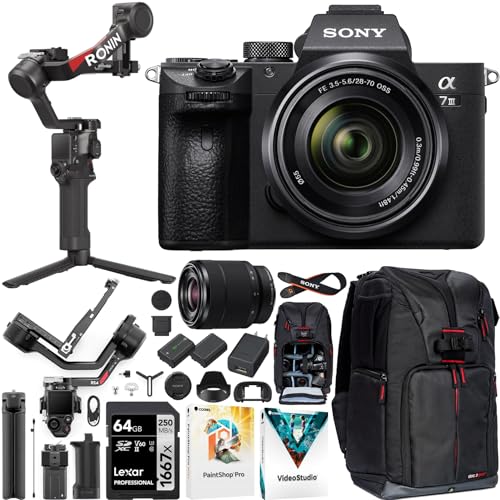
This bundle offers a fantastic entry point into professional full-frame videography with excellent stabilization. The Sony a7 III is a legendary mirrorless camera, celebrated for its robust full-frame sensor, superb autofocus, and strong video capabilities, including 4K HDR. Paired with the versatile DJI RS 4 Gimbal Stabilizer, you get a powerful, relatively lightweight setup that can handle a wide array of shooting scenarios. If you want the reliability of a top-tier mirrorless camera and the smooth moves of a dedicated professional gimbal, this combination is a stellar choice for the best gimbal for full frame mirrorless setups.
-
Key Features (Sony a7 III Camera):
- 24.2MP Back-Illuminated Full-frame CMOS Sensor.
- 5-axis in-body image stabilization (up to 5-step shutter speed advantage).
- Fast Hybrid AF with 693 phase-detection and 425 contrast-detection points (93% coverage).
- High-speed continuous shooting up to 10fps with AF/AE tracking.
- 4K HDR Movie Shooting with full pixel readout and no pixel binning or crop.
- Sensitivity up to ISO 51200 (expandable to 204800 for stills).
- 15-stop dynamic range, 14-bit uncompressed RAW.
-
Key Features (DJI RS 4 Gimbal):
- Lightweight design optimized for mirrorless cameras.
- Automatic axis locks for quick setup and transport.
- Next-gen stabilization algorithm for enhanced smoothness.
- OLED touchscreen for easy mode switching and parameter adjustments.
- Supports various shooting modes like Panorama, Timelapse, and Tracking.
-
Pros:
- Excellent image quality and low-light performance from the a7 III.
- Reliable and fast autofocus for both stills and video.
- DJI RS 4 offers superb stabilization for a wide range of full-frame mirrorless cameras.
- Relatively compact and portable for a full-frame setup.
- Versatile bundle suitable for diverse content creation.
-
Cons:
- Separate camera and gimbal require more setup and balancing time than integrated systems.
- Not as many advanced features as dedicated cinema camera systems.
- Battery life is good but may require spares for long shoots.
-
User Impressions: This bundle is a hit with content creators and indie filmmakers. Users love the a7 III’s image quality and the RS 4’s intuitive operation, noting how easily it transforms handheld footage. Many highlight the ease of balancing and the range of creative possibilities unlocked by the gimbal. It’s often praised as a reliable workhorse for run-and-gun shooting.
Sony Alpha FX3 ILME-FX3 | Full-frame Cinema Line Camera

While not a gimbal itself, the Sony FX3 is a compact full-frame cinema camera specifically designed with handheld and gimbal use in mind, making it a prime candidate for pairing with the best gimbal for full frame operations. It takes the excellent image quality of Sony’s Alpha line and repackages it with a cinema workflow focus, including a cage-free design with mounting points, an active cooling fan for extended recording, and Sony’s renowned S-Cinetone color science. If you need a robust, compact cinema camera that excels on gimbals, the FX3 is an outstanding choice.
-
Key Features:
- 4K full-frame sensor with 15+ stops dynamic range and high sensitivity.
- S-Cinetone for expressive cinematic look, inspired by VENICE colorimetry.
- Records up to 4K 120p 10-bit 4:2:2 with full pixel readout in all modes.
- Compact, cage-free design with multiple ¼”-20 mounting points for accessories.
- XLR top handle included for professional audio input.
- Uninterrupted 4K 60p recording with an in-body cooling fan.
-
Pros:
- Excellent image quality with cinema-grade color science.
- Compact and lightweight, ideal for gimbal use.
- Multiple mounting points for direct accessory attachment without a cage.
- Active cooling system prevents overheating during long takes.
- Outstanding low-light performance.
- Great for professional audio with included XLR handle.
-
Cons:
- Requires a separate gimbal; not an integrated solution.
- No built-in ND filters (requires external filters on lenses).
- Menu system can be complex for newcomers to Sony.
-
User Impressions: The FX3 is a darling of indie filmmakers and videographers. Users consistently praise its incredible low-light capabilities, beautiful S-Cinetone color, and the robust build quality. Its small form factor, combined with the integrated mounting points and active cooling, makes it a go-to camera for gimbal operators, who appreciate its balance and reliability during long shoots.
Frequently Asked Questions (FAQ)
Q1: What is a full-frame gimbal?
A full-frame gimbal is a camera stabilizer specifically designed to handle the larger size and heavier weight of full-frame mirrorless or DSLR cameras, along with their lenses. These gimbals typically have higher payload capacities and more robust motors compared to those designed for smaller cameras, ensuring smooth and stable footage.
Q2: Why do I need a gimbal for my full-frame camera?
Full-frame cameras, while offering superior image quality, can be heavy and difficult to handhold steadily, especially when moving. A gimbal provides 3-axis (or even 4-axis, like the Ronin 4D) stabilization, counteracting unwanted camera movements and vibrations. This results in incredibly smooth, professional-looking footage, eliminating shakiness and allowing for dynamic cinematic shots.
Q3: What payload capacity should I look for in a full-frame gimbal?
Payload capacity is crucial. Always check your camera’s body weight plus the weight of your heaviest lens and any accessories (like a monitor, mic, or wireless transmitter). Your gimbal’s maximum payload should comfortably exceed this total weight. For most full-frame mirrorless setups, a gimbal with a capacity of 6-10 lbs (approx. 2.7-4.5 kg) is a good starting point, but cinema cameras with heavy lenses will require even more.
Q4: Are full-frame gimbals difficult to balance and use?
Modern full-frame gimbals are much easier to balance and operate than older models. Many feature fine-tuning knobs, axis locks, and auto-tune functions that simplify the setup process. While there’s a learning curve to mastering cinematic moves, the initial balancing and basic operation are quite intuitive, especially with models like the DJI RS 4. Integrated systems like the Ronin 4D are even simpler as they come pre-balanced.
Q5: Can I use my existing full-frame lenses with a gimbal?
Yes, absolutely! The gimbals designed for full-frame cameras are built to accommodate a wide range of lenses, from lightweight primes to heavier zooms. However, the total weight of your camera-lens combination must still fall within the gimbal’s specified payload capacity. Some gimbals also offer support for external focus motors to control manual lenses.
Q6: What’s the difference between a 3-axis and a 4-axis gimbal?
Most standard gimbals offer 3-axis stabilization (pan, tilt, roll), which handles horizontal and rotational movements. A 4-axis gimbal, like the DJI Ronin 4D, adds a Z-axis stabilizer. This fourth axis specifically counters vertical bounce and shake, which is common during walking or running shots, providing an even smoother, more ‘floating’ look akin to professional dolly shots.
Q7: What are some common accessories for full-frame gimbals?
Popular accessories include external monitors for better viewing, wireless video transmission systems, follow focus motors for precise focus pulling, external battery grips for extended shooting, and various handles or grips for different shooting styles (e.g., dual-handle setups, underslung modes). These accessories can significantly enhance the functionality and versatility of your gimbal setup.
Conclusion
Choosing the best gimbal for full frame cameras is a pivotal decision for any videographer aiming for professional-grade results. Whether you opt for the integrated cinematic powerhouse of the DJI Ronin 4D, the highly versatile bundle of the Sony a7 III with the DJI RS 4, or build a robust setup around the compact Sony FX3 cinema camera, you’re investing in stability that will transform your footage. Each option brings unique strengths to the table, designed to meet different production needs and budgets. Take your time, consider your workflow, and get ready to capture some truly breathtaking cinematic moments with your full-frame camera!